 Lithuania
Robertas Kaunas
Minister of National Defence, LithuaniaSays the new mission lets NATO's top commander move air defence assets without political debate9.
What to watch
- A cost-sharing agreement for missiles fired on the mission
What one short-range missile costs, by the estimate of retired Lithuanian Maj. Darius Antanaitis1.
Source: LRT, November 13th, 20261
NATO's jets over Estonia, Latvia and Lithuania now fly an air defence mission with wider authority to shoot, on the same four-month rotation as before. The three Baltic states have no fighter jets of their own, so other NATO members take turns guarding their airspace2. NATO leaders agreed the upgrade at their Ankara summit in July, and it took effect on August 1st, 20263. Italy leads at Šiauliai in Lithuania, where six Belgian F-16s joined it in early November, and Turkey flies five F-16s from Ämari in Estonia until November 30th, 20264.
The first tests of the new mission have mostly been stray drones, and they show who pays. NATO jets shot down a drone over Latvia on August 14th, 2026 and another over Lithuania in September5. In early November, jets fired at a suspected Ukrainian drone over Lithuania twice and missed1. Lithuania's defence minister puts each launch at several hundred thousand euros1. The allies on the mission pay that for now, and Lithuania is seeking a deal to share the bill1.
The rotation is not turning into a standing force. NATO says the four-month model continues6, and Estonia's defence minister says the timetable is agreed for three years7. The Baltic presidents asked in May for a permanent NATO fighter presence8. NATO gave them faster rules instead. Lithuania is paying for its own ground-based air defence9, and the visiting air forces pay for the missiles they fire1.
For 22 years, the Baltic mission meant scrambling jets to identify and escort Russian aircraft near the three states2. Lithuania's president, Gitanas Nausėda, said in Ankara that the new mandate lets pilots destroy "objects that pose a threat"10.
The concrete change is in the rules. Political-level consultations are no longer required before a pilot shoots down a drone that enters NATO airspace, Militarnyi, a Ukrainian defence outlet, reported11. Estonia's defence minister, Hanno Pevkur, told ERR, Estonia's public broadcaster, that "all the necessary pre-authorizations for making all possible decisions have already been completed as far in advance as possible"7.
The hardware did not change with the rules. The number of jets at Ämari is not expected to rise significantly in the coming years unless a rapid reinforcement is needed11.
Aircraft deployed, November 2026
Source: IRIA News, November 15th, 20264
Turkey's five F-16s took over Ämari from Portugal at the end of July for a four-month deployment3. They are due to stay until November 30th, 20264. The Estonian Defence Forces' public table of rotations lists no unit after that date2.
The gap is in the public record. NATO says the four-month rotational model continues under the new mission6. Pevkur said in July that the four-month timetable for allies has already been agreed for the next three years7. The open question is which ally comes next.
Borders: Natural Earth.
Sources: IRIA News, November 15th, 20264; Militarnyi, September 15th, 20265; LRT, November 13th, 20261
In early November, a suspected Ukrainian drone entered Lithuania from Belarus1. Jets found it over Kaunas but could not fire above the city, Rear Adm. Giedrius Premeneckas, head of Lithuania's Defence Staff, said1. Debris from one missile fell in Biržai district, and the other apparently failed to fire1.
An IRIS-T missile costs about €400,000 and an AIM-9 Sidewinder between €500,000 and €900,000, retired Maj. Darius Antanaitis told LRT, Lithuania's public broadcaster1. Defence Minister Robertas Kaunas put a launch at several hundred thousand euros1. The mission's participants cover those costs now, and Lithuania is seeking an agreement to share them1.
Euros
Source: LRT, July 16th, 20269
At the 2023 Vilnius summit, NATO pledged rotating ground-based air defence systems for the Baltic states9. The pledge has produced short deployments, such as a Dutch Patriot system in Lithuania for 10 days in 20249. Laurynas Kasčiūnas, deputy chair of the Lithuanian parliament's defence committee, said: "This is certainly not what we expected from the rotational model"9.
Lithuania added €800 million in 2026 to strengthen air defence9. Kasčiūnas says about €5 billion will be needed by 20359.
Tomas Jermalavičius, head of studies at the International Centre for Defence and Security in Tallinn, says the shift should be seen mainly as a political signal that the region is a priority9. He points to a chronic shortage of air defence systems across the alliance9. Kasčiūnas put it plainly9:
To arrange something, you need to have something to arrange. The physical shortage of air defence systems is the biggest challenge
The record supports him on capacity. It does not support him on the rules. A Romanian F-16 already shot down a drone over Estonia in May, under the old mission12. What the upgrade removes is the political call before a shot at a drone11. That shortens the time between finding a drone and firing at it.
Confidence: medium. The rules change and the rotation are documented by NATO, the Estonian Defence Forces and both Baltic public broadcasters. The cost figures are one retired officer's estimates, and no source gives the burden-sharing talks a date.
LithuaniaSays the new mission lets NATO's top commander move air defence assets without political debate9.
 Estonia
Says the four-month timetable is agreed for three years and the pre-authorizations are done7.
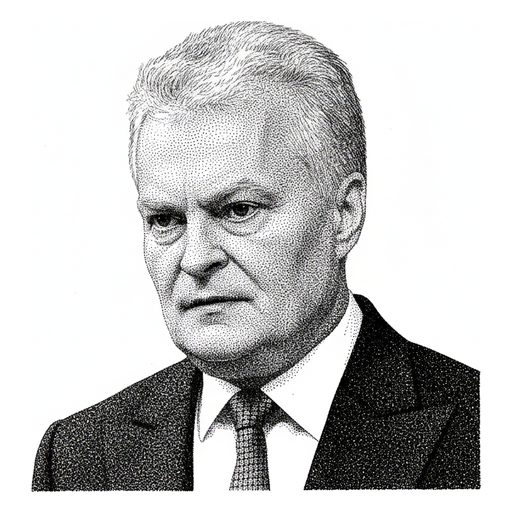 Lithuania
Portraits after photographs. Robertas Kaunas: Unknown author, via Wikimedia Commons, CC BY-SA 4.0; Hanno Pevkur: Ristokaljurand, via Wikimedia Commons, CC BY-SA 4.0; Gitanas Nausėda: European Union, via Wikimedia Commons, Attribution.
What would change our view. A NATO decision to base fighters in the Baltics for good would make the rotation question real. So would a gap at Ämari after November 30th, 2026. Russia's reported demand, in talks on Ukraine, for a ban on NATO bases in the Baltic states makes either a subject for negotiation15.
| Reader | What to do |
|---|---|
| Corporates and defence suppliers | Expect Baltic demand for cheaper ways to stop drones. Arūnas Kumpis, a volunteer drone operator who fought in Ukraine, told LRT that electronic warfare and interceptor drones could do the job1. |
| PE and VC firms (private equity and venture capital) | Read Lithuania's air defence spending, €800 million added in 2026, as a buyer's budget9. |
| Family offices | Treat the Baltic rotation as stable for planning. The timetable is agreed for three years7. |
| Law firms | Watch for a NATO cost-sharing text on missiles fired over host states1. |
Mechanism: high. The rotation and the rules change are documented6,11. Horizon: medium. No source dates the cost-sharing talks.
Analyst assessment. Each call is scored once its date passes.
The Estonian Defence Forces report a NATO ally's air force taking over the air defence detachment at Ämari Air Base after Turkey's rotation
Lithuania announces a signed agreement with NATO allies to share the cost of missiles fired on the Baltic air defence mission
NATO announces a permanent, non-rotational fighter presence in the Baltic states