Article 19 · Politics
Serbia's student protesters are on Sunday's ballot. None of their candidates is a student.
Serbia votes on Sunday 25 October in a snap election for its parliament. The main challenger to Aleksandar Vučić, whose party has ruled for 14 years, is a list built by a student protest movement, and one poll puts it narrowly ahead.
What Serbia is voting on
Serbia elects all 250 members of its parliament, the National Assembly, in one nationwide vote. Each voter picks one party or coalition list, and seats are shared out in proportion to the vote. A list needs at least 3% to win any seats, though lists for recognised ethnic minorities are exempt. Whoever can command a majority in the assembly forms the government.
The vote was not due until late 2027. Aleksandar Vučić, the dominant figure in Serbian politics, made it happen early. His Serbian Progressive Party (SNS) has governed since 2012. On 27 September he resigned as president, five months before his second and last term under the constitution ran out, and called this election. He now leads his party's list as its candidate for prime minister, a post that would keep him in power.
His main opponent is not a party. It is the Student List, running as "Students Win", the electoral arm of a protest movement that has filled Serbia's streets for almost two years. On Thursday about 150,000 of its supporters rallied in central Belgrade, according to the Archive of Public Gatherings, an independent group that counts crowds.
How a station roof started it
On 1 November 2024 a concrete canopy collapsed at the newly renovated railway station in the northern city of Novi Sad and killed 16 people. Evidence pointed to botched changes made during the refurbishment. There is still no official finding on the cause, and no official has been held to account.
Many Serbians blamed corruption in public building work. Three weeks after the disaster, Belgrade students who blocked a road for a vigil were attacked by a mob from the ruling party, and the protests spread across the country. The students ran them through plenums: open assemblies that decide everything by direct vote, with no leaders and no spokespeople. A movement with no leader gave the government's media no one to smear.
The protests brought down a prime minister early on. In late January 2025 the prime minister, Miloš Vučević, a close Vučić ally, resigned a day after tens of thousands of people blocked one of Belgrade's main junctions. Figure 2 sets out the two years from the collapse to the vote.
From the Novi Sad collapse to the election
- 1 Nov 2024The canopy at Novi Sad railway station collapses and kills 16 people.
- Jan 2025Prime minister Miloš Vučević resigns after a mass blockade in Belgrade.
- Apr 2025The plenums adopt the Directive, the rulebook for any list run in the movement's name.
- Jul 2026A CRTA and Stanford University survey puts the students at 45% and the SNS at 36%.
- 6 Sep 2026The plenums hold the final vote on candidates and remove the University of Belgrade's rector.
- 27 Sep 2026Vučić resigns as president and calls a snap parliamentary election.
- 20 Oct 2026The NSPM poll puts the Student List at 44.5% and the Vučić list at 42.7% of decided voters.
- 22 Oct 2026About 150,000 people rally for the Student List in Belgrade.
- 25 Oct 2026Serbia votes. Preliminary results are expected about two hours after polls close at 8pm.
- 27 Dec 2026The deadline for a presidential election.
Source: The Guardian, 21 and 23 October 2026. Reuters, 21 October 2026. Al Jazeera, 23 October 2026. IntelliNews, 20 October 2026. The Loop (ECPR), 21 October 2026.
A list with no students on it
A leaderless movement that runs for parliament risks turning into the kind of party it set out to replace. The students' answer is a strict rulebook, called the Directive, adopted in April 2025. No student may stand: anyone enrolled in 2024/25 is excluded, so that no one could say the students were building careers. Former members of the ruling coalition's 20 parties are barred, and so are former officials of the opposition parties in parliament.
The plenums then vetted every name. In August they challenged 99 of more than 300 possible candidates, and in September 38 candidates and reserves were removed. The best-known casualty was Vladan Đokić, rector of the University of Belgrade, who had backed the protests from the start and was widely expected to lead the list. Of the 85 student assemblies voting, 43 voted him off. None of these rules has legal force, and no one removed refused to go.
What remains is a list of 250 people, most of them nominated by university faculties and more than 160 of them holding doctorates, with farmers and a popular rapper among the rest. It is led by Ilija Srdanović, a cardiologist and professor in Novi Sad who was little known before the campaign. He is pictured below beside Vučić.
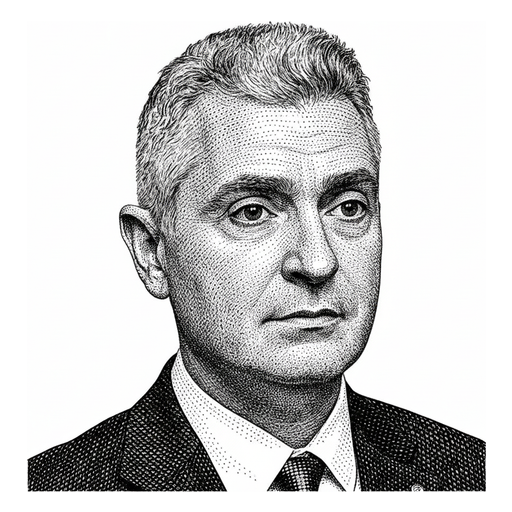
Ilija Srdanović
Head of the Student ListA cardiologist and university professor in Novi Sad, chosen through the plenums to lead the list of 250.

Aleksandar Vučić
SNS candidate for prime ministerResigned as president in September to lead the ruling party's list. He was Slobodan Milošević's information minister during the Kosovo conflict.
The programme
The programme was also decided by the plenums. It has 11 points, starting with the rule of law and the fight against corruption. The slogan asks "Serbia or Mafia?", aimed at the widespread belief that the ruling party has ties to organised crime. The government denies the accusations.
Issues that split voters have been kept low. Membership of the European Union would be left to a referendum, which candidates have floated holding within six months of taking office. The list calls Kosovo an integral part of Serbia, though stalled talks with Kosovo are one reason Serbia's path to the EU is blocked. Candidates have also signalled no change in relations with Russia. Igor Bandovic of the Belgrade Centre for Security Policy calls foreign policy the biggest unknown in the programme.
The polls
Polls disagree. Only one was published this month, by the New Serbian Political Thought (NSPM) institute on 20 October. It puts the Student List at 44.5% of decided voters and the Vučić list at 42.7% (Figure 1). It asked 1,050 people by telephone between 25 September and 5 October. Another 18.3% were undecided and left out of those figures, and NSPM says they are not a forecast of the result.
In July a survey by CRTA, a Serbian pro-democracy group, and Stanford University put the students at 45% and the SNS at 36%, before Vučić resigned and his campaign began. Other domestic polls show the SNS ahead, though the opposition sees those pollsters as close to the government. Bookmakers favour Vučić.
Three smaller lists sit just under the 3% bar in the NSPM poll, including the Socialist Party, part of the ruling coalition. Whether they clear it changes how the seats divide. Parties for ethnic minorities, such as Hungarians and Bosniaks, need no minimum and could decide who governs in a close result.
Share of decided voters in the NSPM poll
Telephone survey of 1,050 people, 25 September to 5 October 2026. A list needs 3% to win seats.
Source: NSPM, published 20 October 2026, via IntelliNews.
An uneven field
The ruling party controls the state and most of the airwaves. A CRTA survey in September found that 69% of air time on Serbian television went to the ruling majority. Vučić made 129 live television appearances in August, more than four times his total for July.
The students accuse the foreign ministry of shaping the vote abroad, keeping polling stations open where Vučić is strong and closing them where the opposition could do well. The ministry did not answer the Guardian's request for comment. On 16 October ten prominent journalists resigned from N1, a channel critical of the government, citing a shrinking space for independent reporting.
Days before the vote a former ruling-party activist, Momčilo Marjanović, told the Balkan Investigative Reporting Network that he had led groups of men paid to intimidate voters and use force at student protests. He said he was paid through a fake job at a public utility. The organised crime prosecutor says it will investigate. Past elections drew claims of vote-buying and ballot-box stuffing, so the students plan to send more monitors to polling stations than any opposition has before.
After Sunday
Polls close at 8pm, and preliminary results are expected about two hours later. Observers quoted by the Guardian expect a close race in which neither side is ready to accept a loss. If his hold on power is threatened, Vučić can push for repeated recounts. The movement has spent recent weeks planning street action to defend a win. Diplomats in Belgrade think EXPO 2027, the major international event Serbia hosts next year, could hold back violence.
Not everyone expects a students' victory. Gordana Čomić, a former opposition politician who later served as a minister in the SNS government, predicts the list will take about 80 of the 250 seats and then fall apart. Radivoje Grujić, an election consultant, says its only route to power is people who have never voted.
If the list wins, the movement loses its hold on its own members of parliament. The plenums can strike a name off the list before an election, but once someone is elected the seat belongs to that person, and the movement cannot take it back. A presidential election is also due by 27 December. The plenums have a procedure for choosing a candidate, who would be the first person the movement puts forward on their own.
What to watch
- Turnout on Sunday, and whether people who have never voted come out.
- Whether the Socialist Party and the other small lists clear the 3% bar.
- Any call for recounts, and how many polling stations the students' monitors cover.
- Whether either side refuses to accept the result, and what happens on the streets the next day.
- Who the plenums choose for the presidential election due by 27 December.