Article 16 · Shipping
Egypt is about to vote on joining a war. The Suez Canal is the thing to watch.
On 26 October Egypt's parliament votes on letting President Sisi send forces to defend Saudi Arabia against the Houthis. No force has been named. The cost of getting it wrong sits in a canal that earned $567.1 million in August.
What happens on 26 October
Egypt's constitution does not let the president send the army to fight abroad on his own. Article 152 says he must first take the opinion of the National Defense Council, then win the approval of two-thirds of all members of parliament.
President Abdel Fattah el-Sisi asked for that approval on 17 October. Houthi missiles and drones had hit Saudi Arabia for a week, including a strike on Riyadh's main airport on 10 October that killed 13 people. The council met the next day and promised Saudi Arabia "all necessary and possible forms of support".
Parliament then debated behind closed doors for two days and put the vote off to Monday 26 October. It needs 398 of the chamber's 596 members, by roll call. Opposition parties hold 53 of the 568 elected seats, so the mandate is expected to pass.
What is less clear is what the mandate says. The notice to lawmakers gave no detail, and one member called it "open-ended and vague". A judicial source told Mada Masr that an "authorize me and I'll handle it" mandate would be unconstitutional.
What Egypt has actually promised
Less than the headlines suggest. The council's statement named no units, no size and no date. A lawmaker close to the state wrote on X that the council had approved forces on "a defensive mission", but no official source has confirmed that.
The people who talk to Egyptian reporters describe a limited role: air defence units inside Saudi Arabia, naval forces in the Red Sea, and at most limited strikes on targets at sea. Nobody in government is describing ground combat in Yemen.
Egypt's reported forces in the Gulf before this crisis were a small detachment and a squadron of Rafale fighter jets in the United Arab Emirates, disclosed in May. Approving the request would not by itself send anyone anywhere. Saudi Arabia would have to ask, and the mission would have to be defined.
The week is set out in Figure 2 below.
Why the canal is the thing to watch
The Suez Canal is one of Egypt's main sources of foreign currency, and the Houthis have already shown what they can do to it. When their attacks on Red Sea shipping began, big container lines went round Africa instead. Egypt's prime minister, Mostafa Madbouly, said this month that canal revenue fell from about $10 billion a year to $3.3 billion, and has since climbed back to about $4.4 billion.
Figure 1 shows those three numbers side by side. The recovery is real but partial: in August the canal saw 1,358 ships and earned $567.1 million. The canal authority puts the loss from the Houthi attacks at around $11 billion.
The risk now is not that the Houthis attack the canal itself. It is that they treat ships heading for it as fair game once Egypt is a party to the war. A Middle East Eye columnist put it plainly: the Houthis would not need to strike the canal to undermine its revenues. An opposition member of parliament, Freddy el-Bayadi, made the same point in the debate.
Suez Canal revenue a year: before the Red Sea attacks, at the low point, and now
Source: Prime Minister Mostafa Madbouly, CNN Business Arabic interview, 4 October 2026, as reported by The Rio Times. Rounded figures.
The money behind the decision
Egypt's finances lean on the Gulf. Gulf states hold about $18 billion in deposits at Egypt's central bank, and S&P says about 70% of the remittances Egyptians send home come from the Gulf. The IMF's $8 billion programme for Egypt runs to December 2026.
One deposit matters this month. Saudi Arabia has $5.3 billion at Egypt's central bank that falls due in October, along with $267 million in interest. Cairo has been negotiating its renewal.
None of the sources we read links the vote to the deposit, and nobody in Cairo says so out loud. But the two decisions sit on the same desk in the same month, and a reader can draw the line without help.
What the Houthis have said
The warning to Cairo so far has come from Yahya al-Raei, speaker of the Houthi-run parliament in Sanaa. He wrote to his Egyptian counterpart that joining the war would pose "a grave danger to its national security and internal stability". The Houthi military command has said nothing about Egypt in the sources we read.
Cairo is talking to the other side too. Foreign Minister Badr Abdelatty met Iran's foreign minister in Baghdad on 17 October, the day Sisi asked for the mandate. A lawmaker close to the state says the week's delay in the vote is tied to Egyptian efforts to broker a settlement in Yemen.
How one week turned into a war vote
- 10 OctA Houthi strike on Riyadh's King Khalid International Airport kills 13 people.
- 13 OctForeign Minister Abdelatty says Cairo is seriously considering joining the Saudi-led defence pact.
- 17 OctSisi asks parliament for an emergency session to give him a mandate "if we are asked". The Houthi parliament speaker writes to Cairo in protest.
- 18 OctThe National Defense Council pledges "all necessary and possible forms of support". Parliament holds its first closed session.
- 19 OctAfter a second session the Speaker adjourns the debate to 26 October.
- 26 OctThe roll-call vote. It needs 398 of 596 members.
What history says
Egypt has been here before, and the memory is why officials keep saying "defensive". In the 1960s it sent troops to Yemen's civil war. The intervention began small and grew to around 70,000 soldiers, and estimates of Egyptians killed range from 10,000 to 26,000.
Since then Cairo has kept its distance from Yemen's ground. In 2015 it joined the Saudi-led campaign with four naval vessels at Bab al-Mandab and aircraft, and no ground troops. Its last big foreign ground deployment was the 1991 Gulf War, to free Kuwait.
Parliament has granted this kind of mandate once under the current constitution. In 2020 members voted unanimously, in closed session, to allow combat missions abroad as fighting in Libya neared Egypt's western border. No large force followed.
What to watch
The three men pictured below hold the next week. Our alert on the vote, AL37 in the Intel section, carries the full sourcing, the risk matrix and five dated calls. They cover the vote passing and any Egyptian deployment following by year end.
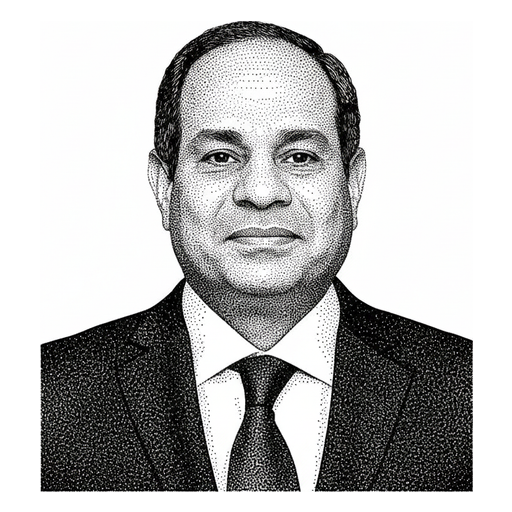
Abdel Fattah el-Sisi
President of EgyptAsked for the mandate and says Egypt is speaking "only in defense".

Hesham Badawy
Speaker of the HouseRan the closed sessions and adjourned the vote to 26 October.

Yahya al-Raei
Speaker of the Houthi-run parliamentWarned Cairo that joining would endanger Egypt's own stability.
- The roll call on 26 October, and the exact wording parliament approves.
- A formal Saudi request. The Associated Press reported in September that Riyadh had asked Egypt and others for defensive help; none has been reported in this round.
- The Egyptian armed forces spokesperson. A named unit, base or sea area would be the first real step.
- Any Houthi military statement that names Egypt, Egyptian ships or the canal.
- The Suez Canal Authority's September figures, against August's 1,358 ships and $567.1 million.
- Whether the Saudi deposit is rolled over, in the central bank's data or a cabinet statement.
Sources
- Mada Masr, "Parliament puts off vote on authorizing Sisi to send troops to Saudi Arabia until Tuesday", 18 October 2026.
- Al Manassa, "Egypt's parliament delays vote on El-Sisi's Saudi defense mandate", 19 October 2026, and "Parliament extends emergency debate on Saudi military mandate", 18 October 2026.
- Asharq Al-Awsat, "Egypt Extends to Next Week Discussions on Military Support for Saudi Arabia", 20 October 2026.
- Alhurra, "Egyptian Lawmakers Push Back on Sisi's Request to Send Troops to Saudi Arabia", 20 October 2026.
- Reuters, "What's behind Egypt's move towards possible military involvement in Saudi-Yemen war?", 19 October 2026.
- Anadolu Agency, "Egypt's defense council pledges 'all forms of support'", 18 October 2026, and "Bab al-Mandeb tensions test Egypt's Suez Canal", 22 September 2026.
- The National, "Egypt pledges support for Saudi Arabia as Houthis warn Cairo", 18 October 2026.
- The Rio Times, "Suez Canal Revenue Still Far Below Peak, Egypt Says", 5 October 2026.
- S&P Global Ratings, "Egypt 'B/B' Ratings Affirmed; Outlook Stable", 10 April 2026.
- Vektora, alert AL37, "Egypt's Parliament Votes on 26 October on Sending Forces to Defend Saudi Arabia", 21 October 2026.